Do you often pick up your phone and stare at it? Do you think that you can’t live without it? Then you may also have a smartphone addiction. Research says that the more you use your phone daily, the smaller your brain size becomes. The reason for this is that our human brain, which has evolved very slowly over the past 6 million years, cannot cope with the rapidly growing technology. 44 percent of the people in our country have a smartphone addiction.
How can we say this? Just as people who have a smoking habit cannot live without cigarettes, similarly, people who have this smartphone addiction cannot live without their phones. Experts say that a person can spend an extra 2 hours of screen time per day in addition to their office time. But an average Indian uses their phone for more than 6.5 hours a day.
Why is this? In a survey conducted in our office, 86 percent of people use their smartphones for more than 2 hours a day. If you think that what is the big problem with just 2 hours, then that is a big problem. Let’s find out how to get out of this problem.
You all know that there is a chemical called dopamine in our brain. What this dopamine does is that it makes us appreciate you and say, “You are doing a good job,” and at the same time, it motivates us and says, “You can do it.” When this dopamine is released, it is released when we get high marks in our tests or when we eat delicious food.
This same dopamine is released whenever we watch a video we like on our phone, when we receive a text or a post from someone we like, when we complete a difficult level in a game, and even when we receive a random notification. Children also get a similar dopamine release when they see colorful objects that move brightly.
There is a region in the midbrain of our brain called the VTA, or ventral tegmental area. Dopamine is released from here. From there, it goes to the nucleus accumbens region. Let’s call this route the mesolimbic pathway.
Dopamine is a neurotransmitter, meaning it passes from one nerve cell to another. This is how dopamine, the reward hormone, is activated in us. When this dopamine is naturally released, it gives us a reward in our lives and makes us live happily. Many teenagers today do not think much about the appreciation of their parents. The reason for this is that they get more dopamine from gaming than they get naturally.
If you look at the dopamine released by mobile phones, it is released excessively and repeatedly. Due to this, our brain gets used to the high dose of dopamine, so the small things in life become worthless. What does the area of the brain like the hippocampus, i.e. the memory center, and striatum, i.e. the habit maker, do? When we do something, we release more feel-good hormones, which teaches us to do it and makes us do it again and again. This is the cause of addiction.
Smartphone Addiction and Dopamine Release
That’s why even if we think we’ve watched our reels for a long time, we can’t stop it and keep swiping like this. What would our children do if we, who have more self-control, did something like this? According to a survey we conducted in our office, 58 percent of people check their phones every 5 to 10 minutes. Of that, 62 percent watch shorts and reels. The apps on our phones are designed to release a high dose of dopamine into our brains.
Now, if someone woke us up every 10 minutes while we were sleeping peacefully at night, wouldn’t our sleep be disturbed? In the same way, this notification comes into our lives and disturbs us from doing our daily tasks. “I’m the only one who uses my phone; everyone else does it. “Why don’t you use it?” You may ask. But many people here don’t know what problems there are with this phone.
This smartphone, a device like this, when we have it in our hands, affects our behavior, our thinking, and our concentration. Now, when I look at this phone, I don’t get any calls, but because I have this phone in my hand, the things I talk about have no value. This is the psychological power of this device. Not only that, many people now listen to our conversations half-heartedly by holding the phone. They can’t even remember the things they listen to properly, and their memory power also decreases due to phone addiction.
Physical Problems Caused by Smartphone Addiction
Now, we have become addicted to people who use phones, so when they do, they get tense and then depressed. All this is because of addiction. Using your phone all night long can make you sleepy and leave you with digital eye strain.
Holding your phone in the same posture and using it can cause neck pain, shoulder pain, and back pain, as well as laziness. We waste our precious time, which we can’t get back no matter how much money we pay, by watching useless content.
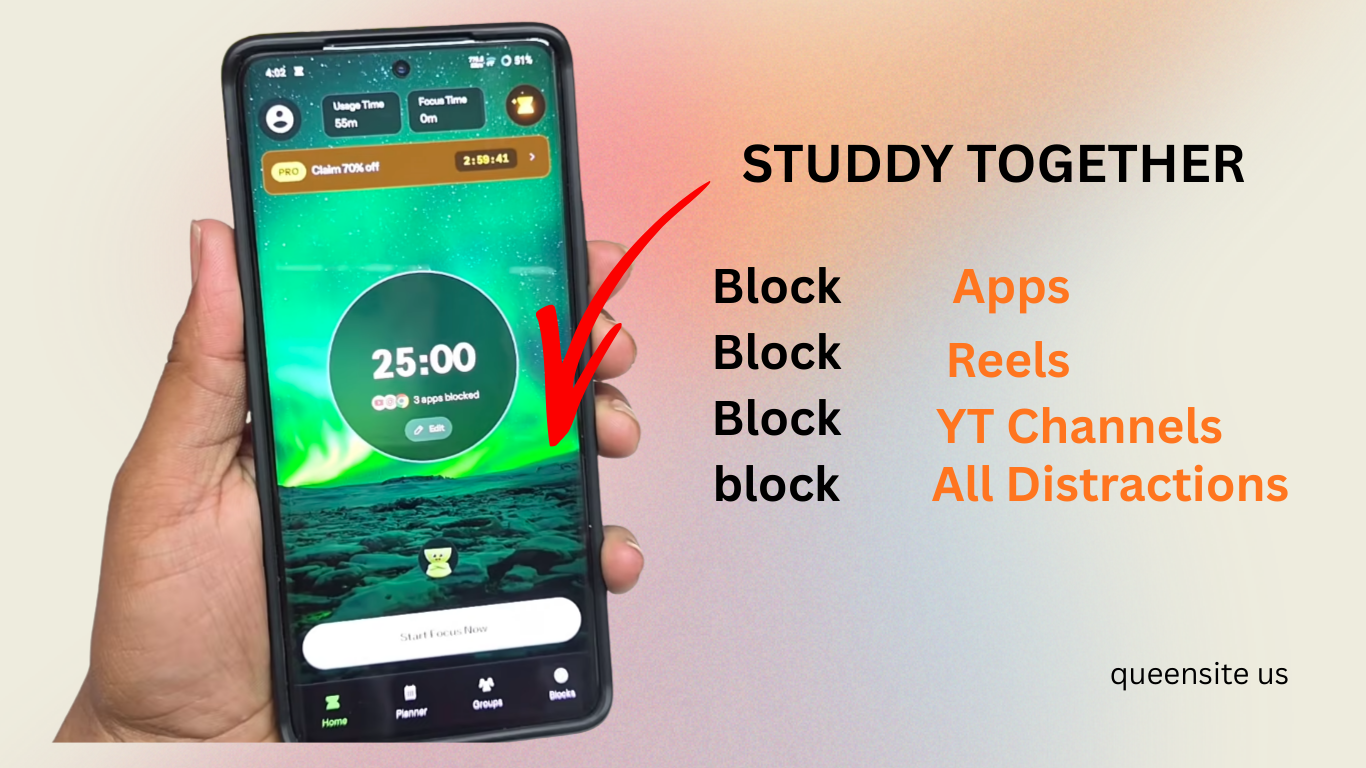
But we can’t help but use our phones completely. Big companies like YouTube and Instagram are trying to make us all addicted to them, with talented engineers. So, shouldn’t there be a strong team to help us get out of that addiction? Regain Mindful Screen Time was created for such a team. This app will immediately ask you which apps are distracting you. After you install it, a pop-up will appear when you open that distracting app. It will ask you how long you are going to use this app. A warning pop-up will also appear when you go beyond that limit.
Now we are getting tired of being around people who use their phones, so if they do, they will get tense, then depressed. All this is because of addiction. Using the phone all night long and losing sleep is the only thing left for the eyes: digital eye strain. Holding the phone in the same posture and using it, we have neck pain, shoulder pain, back pain, and laziness. We are wasting our precious time, which we cannot get back no matter how much money we pay, by watching useless content.
Explore how government schemes like the e‑Shram Card Benefits
But we cannot stop using our phones completely. Big companies like YouTube and Instagram are trying to make us all addicted to them with their talented engineers. So, to get out of that addiction, shouldn’t there be a strong team? This Regain Mindful Screen Time was created for such a team. As soon as you install this app, it will ask you which apps are distracting you. After you install it, a pop-up will appear when you open that distracting app. It will ask you how long you are going to watch this app. When we go beyond that limit, a warning pop-up will appear.
This is how this app reduces unnecessary phone usage. It encourages mindful phone usage when needed. Not only that, this app also reduces unwanted social media temptation. It has a feature called notification scheduling. Through this, we can set our phone to show us unnecessary notifications only four times a day.
This notification is the main reason why we often use unnecessary apps at times when we don’t need them. By doing this, we can avoid being disturbed from our regular work and using our phone. So personally, you can find out how much time you are wasting and reduce your phone usage, and this app is very useful for that. Apart from this, if you feel that you are using Instagram too much, delete the Instagram app on your phone and log in to the Hop an Hour system daily and look at Instagram. You will feel lazy to log in frequently, and you will reduce your Instagram usage.
Also, when someone contacts you directly, set it so that you only get notifications for their calls and messages. Just as we lie down in bed at night, we should also prepare a bed for our phone, and it should be far away from our bed. By saying good night to the phone like this, we can sleep peacefully.
If we do not limit our phone use, the children in our house will also limit it. According to WHO guidelines, a child under one year old should not be shown TV or a mobile phone. A two-year-old child can be shown one hour of screen time, but not continuously.
A three- to four-year-old child can be shown one hour of active screen time. Research says that if children have too much screen time, their development will be affected, so stop showing mobile phones to children and encourage them to be active.
If they need it for their academics, then buy them a less-handy device like a laptop or a tablet, monitor what type of content they are watching, and completely restrict addictive content like reels and shorts. If you have installed the app I mentioned on the devices your children use, then you can set their screen time yourself.
So, if you have seen any changes using this tip I mentioned, please let us know in the comments. Congratulations on regaining your lost time.